A Quick Word…
I’ve been a DM for over twenty years. Ever since my good friend Sean showed me a program he used to make maps, I was hooked. Since then, I’ve explored using all kinds of rulesets and mechanics. Some were amazing in theory but cumbersome in practice. Others fit just right. When I started DM-ing my playgroup used D&D 3.5. There were so many numbers, feats, and rules to keep track of and I LOVED IT! Then, 4th edition came along and changed everything so much, we ignored it completely. It wasn’t until years later that we made the switch to Pathfinder 1e. That was our home for a long time; but over the years, 3rd party content, subsystems, and my own creativity sought to continue refining the “perfect game.” Around ten years into my service as a forever DM, I realized most campaigns stalled as the levels grew higher. Challenges became harder to scale, and the glorious thrill of barely surviving was lost. By following the rules exactly, I once had a player kill an entire stadium of coliseum fans in a single action (thanks a lot, great cleave.) Thus, what I consider perfect TO ME is capturing the gritty low fantasy flavor of heroics and horror. The rules listed below have been added over the years, refined, tweaked and adjusted to what they are today. To call what I DM “Dungeons and Dragons” is not entirely accurate. While it is no longer truly Dungeons and Dragons, the rules capture the spirit and community of the game. I have tried to provide links to rules I did not create myself to give other creatives credit.
Feel free to use these changes in your own games, or don’t. It simply feels right to me. But should you be brave enough to try…May it bring you deliciously dangerous adventures.
-Nic Olsen, Forever DM
E6? What the hell is that?
E6 was first described to me as what felt like a fever dream.
“No! No, I’m telling you! Gandalf was only a level 6 wizard at most!” Ken shouted, righteous fury coursing through his veins.
“You’re out of your mind! Gandalf is easily a level 20 wizard!” Max spat back, preparing to die for his beliefs.
“Then why is the highest level spell he casts fireball?!” Ken roared, eyes turning a shade darker than the Balrog. “You only need to be 6th level for that!”
The table fell silent and wept.
E6 is essentially the idea that the strongest characters in the world are level six. And rather than leveling up beyond it, you would level up each time and learn a new feat instead. This method ensures that a CR 9 Dragon is always a threat, not only to the commoners, but the PCs as well. If you roll poorly or get ambushed, you could be killed in one on one combat against a warrior half your level. A crossbow and poison are always lethal and your players can’t just cast f*****g fly to go around EVERY OBSTACLE YOU CREATE!
I digress. E6 keeps things grounded, low fantasy, and fosters an environment where roleplay and strategy are king. Murder hobos find no quarter here, and every noble is typically treated with respect, lest the players wish to test the dozen knights standing at attention.
The Unchained Action Economy
When D&D 5e came out, all us Pathfinder 1e players were mesmerized by the addition of advantage, disadvantage, and how much simpler they made DM decisions. Instead of needing to know the exact numbers for half cover, flanking, or mounted combat, you just needed to ask yourself, “Who has advantage in this situation?” and adjust your rolls accordingly. But the thing that really wet my whistle was how they broke up combat. Instead of a BAB of +20/15/10/5, you simply had 3 actions you could take. Move, Bonus, Action.
Well Pathfinder said, “Hold my beer,” and created the Unchained Action Economy, improving upon the simplicity and adding even more options for those of us who strive to make combat more engaging than “I hit it!”
Fighting Spirit and Vitality
This one is a Nic Olsen original. While there are many like it… This one is mine.
After years of play, I hated how fast everyone healed. It just killed the immersion for me. My hero was literally on the brink of death, burned with dragonfire, skewered through the stomach by an enemies blade, while a vampire drank me dry… But with an 8 hour rest and the Cleric’s magic fingers and I’m right as rain! Lets get to stabbin’ again!
Thus, this system was made to solve that problem.
Fighting Spirit
Hit Points are now called Fighting Spirit, and represent your ability to defend yourself, your tenacity, pain tolerance, morale, and will to continue. It is run exactly the same as HP, except for narratively. When a player takes Fighting Spirit damage, instead of being slashed with a blade, they narrowly dodge or muscle spasms while they parry. So long as a character has fighting spirit, no blood has been shed.
Vitality
All characters now track a new stat called Vitality. It is 1/3 of the characters max Fighting Spirit.
When a character gets hurt, if they have ANY Fighting Spirit at all, they take the damage to their Fighting Spirit. It’s assumed they mostly defended themselves, dodged, or overcame the pain. They took a hit, but it wore them down more than it hurt them.
If a character has NO Fighting Spirit, the damage is applied to their Vitality. They didn’t defend themselves. They are too exhausted, and they took a serious injury. Typically, I have the players describe their glorious new scar after taking Vitality Damage.
All damage must be applied completely to Fighting Spirit OR Vitality. If a character has 3 Fighting Spirit left and takes 7 damage, they now have 0 Fighting Spirit and the spillover damage is ignored.
When a Character is Out of Fighting Spirit
When a character has 0 Fighting Spirit, they suffer a condition called “Dispirited.” Basically, pain, exhaustion, and lost morale is now affecting them. They can’t fight effectively, and they can’t ignore the pain of the injuries they sustain.
A dispirited creature has disadvantage on all rolls. A creature with even one Fighting Spirit is no longer dispirited.
Vitality Points and Constitution Damage, Drain, and Penalties:
A creature’s Vitality Points and Constitution Score are intrinsically linked. For each point of Constitution Damage a creature takes, it loses 2 Vitality Points. When a creature takes a penalty to its Constitution Score or its Constitution is drained, it loses 1 Vitality Point per point of drain or per penalty for the duration of the penalty or drain. A penalty to Constitution or Constitution Drain has no effect on the creature’s Fighting Spirit.
Regaining Fighting Spirit and Vitality
A creature can regain Fighting Spirit and Vitality in a number of ways; but generally, it is easier to regain Fighting Spirit.
Healing Spells and Effects: When casting healing spells or using an ability with a healing effect (such as channeling holy energy on living creatures or the paladin's lay on hands ability), the creature casting the spell or using the effect must choose whether it wants to heal its Fighting Spirit. The creature decides this before casting the spell or using the ability. When that creature decides to heal its Fighting Spirit, the healing spell or effect acts normally, replenishing a number of Fighting Spirit equal to the number of hit points the spell or effect would normally heal. If the creature decides to heal its Vitality, it heals a number of Vitality Points equal to the number of dice it would normally roll for the healing spell or effect. In the case of effects like the heal spell, where a spell or effect heals 10 hit points per caster level, the creature heals its caster level in Vitality. For instance, if a 12th-level cleric uses her channel positive energy power to replenish Vitality to living creatures, she would typically heal 6 Vitality Points for all living creatures with her channel energy burst. If she casts the heal spell, she would restore 12 Vitality Points to the creature she touches.
Rest: When a creature has a full night’s rest (8 hours of sleep or more), that creature regains its level plus its con modifier in Fighting Spirit Points. If there is significant interruption during a rest, the creature regains neither Vitality nor Fighting Spirit. If a creature undergoes complete bed rest for an entire day, it regains double the normal Fighting Spirit received. If a creature does full bedrest for a week, they heal 1 Vitality Point.
Restoration and Similar Effects: When a creature regains Constitution Points by way of the restoration spell or of similar effect, that creature regains 2 Vitality Points for every Constitution Point regained. Relieving a Constitution penalty or Constitution drain regains any Vitality Points that were lost from that penalty or drain.
Critical Hits: When a creature is subject to a critical hit, it deals normal damage but reduces Fighting Spirit and Vitality Points simultaneously. Fighting Spirit damage is equal to the roll of dice of the critical damage; and the Vitality Point damage is equal to half of the roll of dice. If a critical hit is dealt to a player with no Fighting Spirit, they instead take full normal damage to their Vitality.
Other Considerations
The following are a few other considerations to take into account when using this system:
Temporary Hit Points: When a creature would normally gain temporary hit points, it gains temporary Fighting Spirit instead. When that creature takes damage, it loses the temporary Fighting Spirit Points first. If an attack deals damage to only Vitality Points, the temporary Fighting Spirit Points are not lost.
Nonlethal Damage: When a creature takes nonlethal damage, it takes that damage to only Fighting Spirit, even if the attack deals more damage than the creature’s Fighting Spirit. If the creature has no Fighting Spirit, each time that creature takes damage from an attack that deals nonlethal damage, it takes 1 Vitality Point of damage, or a number of Vitality Points in damage equal to the attack’s critical hit modifier (if the attack is a critical hit).
Spells or Effects with Hit Point Triggers: When using this system, if a spell or an ability has an effect that occurs when you reduce a creature to 0 or fewer hit points (such as the disintegrate spell), that effect deals an amount of Vitality Damage equal to the number of dice the creature would roll for that effect. If the effect deals a number of points per caster level (such as the harm spell), it deals a number of Vitality Points equal to the caster level of the spell. In the case of the harm spell or a similar effect where a creature cannot be reduced below 1 hit point by the spell or effect, a creature’s Vitality Points cannot be reduced to or below that creature’s Constitution modifier.
Death Saving Throws
This was taken from 5E. Whenever you start your turn with 0 Vitality Points, you must make a special saving throw called “a death saving throw” to determine whether you creep closer to death or hang onto life. Unlike other saving throws, this one isn’t tied to any ability score. You are in the hands of fate now.
Roll a D20. If the roll is 10 or higher, you succeed. Otherwise, you fail. A success or failure has no effect by itself. On your third success, you become stable (see below). On your third failure, you die. The successes and failures don’t need to be consecutive; keep track of both until you collect three of a kind. The number of both is reset to zero when you regain any hit points or become stable through the healing skill.
Rolling 1 or 20. When you make a death saving throw and roll a 1 on the D20, it counts as two failures. If you roll a 20 on the D20, you immediately regain 1 Vitality Point.
Damage at 0 Hit Points:
Once you hit 0 Vitality Points, you are dying. Any damage sustained at this time counts as a failed death saving throw.
Stabilizing a Creature
The best way to save a creature with 0 Vitality Points is to heal it. If healing is unavailable, the creature can at least be stabilized so that it isn’t killed by a failed death saving throw.
Upon a successful healing check to stabilize, the creature gains one Fighting Spirit. If they don’t receive additional healing, they gain 1 Vitality Point after 1D4 hours.
Resurrection:
There is no resurrection in my game. Should the dice betray you, the curtain closes. That said, I feel it’s good practice to allow your player’s character to remain conscious throughout their death saving throws. Let them speak, have last words, or even a glorious final moment before the darkness takes them.
Stress
In order to increase immersion, I’ve found the addition of stress really raises tension, roleplay, and brings home the gritty feel of a grimdark campaign. I did not create the system but have used it in every game since discovering it!
Reducing Stress: In addition to what’s listed within the link, I’ve added stress reduction based on the “rest” conditions of where the players stay, if they commit themselves to restful sleep.
Castle: -5 Stress
Manor / Estate: - 4 Stress
Fine Tavern: -3 Stress
Tavern: -2 Stress
Enclosed Shelter (4 walls, a bed and a roof): -1 Stress
Tent (camping, bedroll): -0 Stress
Finally, I provide stress equal to the CR of whatever obstacle the players face at the BEGINNING of the encounter as a gentleman’s tip of the cap and warning of what’s to come. This helps temper level 1 characters from fighting CR 7 monsters.
BOOM. 7 stress then ask them how seeing such a monstrosity makes them feel and the delicious roleplay begins.
Magic
Ah magic… often times it’s the reason we play the game. Other times it unravels an adventure the DM spent hours working on in a heartbeat. While many games enjoy high levels of fantasy and incredible spells slung as easily as breathing, I find that degree of power fantasy often derails campaigns. When create water and goodberry exist as level 0 spells and anyone can be a mage, I find it hard to imagine a “traditional medieval world” where so many games are set.
Thus, I have completely reworked magic. It is not like D&D magic, but I find it more fun, rewarding, interesting, and allows for ample roleplay. It is not for everyone, but perhaps you will enjoy it.
Spell Points - The Reservoirs of Mana
Any character may take the feat, Arcane Connection, but the Bard, Cleric, Druid, Paladin, Ranger, Sorcerer, and Wizard gain it for free.
When casting a spell, you spend Spell Points equal to the level of the spell. You no longer need to prepare spells in advance, nor are you limited to a single spell list. See the feat below for more details on Spell Points.
Arcane Connection
Type: General
Prerequisites: None
Benefit: Through a method of your choosing, you have managed to connect to the deep well of Arcane Power coursing throughout the world. Select one of the following abilities as your casting ability score. This choice is permanent and cannot be changed.
Intelligence: You practice learned magic through careful study, formulas, and arcane theory.
Wisdom: You possess a mystic connection to the arcane via your intuition, meditation, prayer, dreams, or spiritual insight.
Charisma: You wield magic through the force of your personality and emotions (raw willpower, passion, or force of presence).
Once this choice is made, you gain a pool of Spell Points equal to your character level + your casting ability score modifier (minimum 1). As you level up, your pool of spell points increases with your level. Additionally, you learn four 0-level spells, and a number of 1st-level spells equal to your casting stat modifier. Spell Points replenish after gaining 8 hours of restful sleep.
Learning Spells:
All spellcasters are capable of learning spells depending on their casting ability.
Intelligence: Through the use of a spellbook.
Wisdom: Through a deeper understanding of mysticism or truth.
Charisma: Through memorization of language or intense connection of feeling.
Upon leveling up, the Bard, Cleric, Druid, Paladin, and Ranger all learn 1 more spell at the highest level or lower allowed on their class sheet. The Sorcerer and Wizard learn 2 spells.
At any point, a character may also attempt to learn a spell by copying them out of other spellbooks, tutelage with another mage, or ripping the power from the monsters in the land. Regular pathfinder rules apply.
Empowered Cantrips:
The Sorcerer and Wizard also gain the following feat for free at 1st level.
Empowered Cantrip
Type: General
Prerequisites: Sorcerer or Wizard Level 1
Benefit: While the rules of spellcasting still apply to you, your mastery over cantrips is unmatched. You learn 2 additional 0 level spells, and learn the following 3 abilities that can be done as 2 actions.
Minor Bane: Impose a -1 on a roll type of your choosing. This bane remains for 1 minute and disappears after it is used. The roll type must be selected at the time of casting. If targeting someone other than yourself, a will save can negate the effect.
Minor Boon: Grant a +1 on a roll type of your choosing. This boon remains for 1 minute and disappears after it is used. The roll type must be selected at the time of casting. If targeting someone other than yourself, a will save can negate the effect.
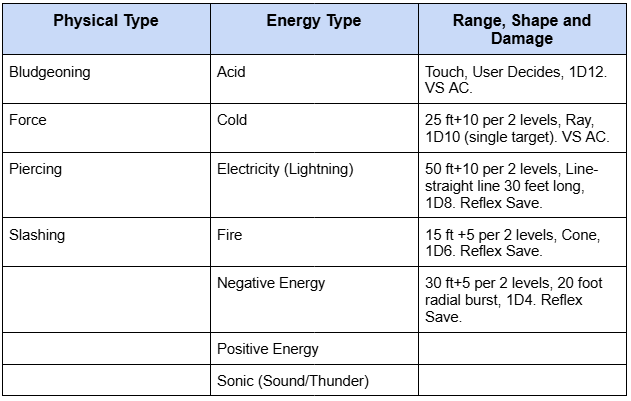
Arcane Power: Select damage types from the following list by combining an aspect from each list in order to create a damaging spell for any scenario. You add your casting ability modifier to attack and damage rolls.
Arcane Strain
Since magic is a volatile, dangerous, and corrupting force, each time a mage casts a spell, they experience Arcane Strain. For each level of the spell slot, they gain that many Strain Points. For every 10 points of strain a person has, they experience an Arcane Trauma (which is rolled randomly on the list below).
On a successful night of rest, a person reduces their Arcane Strain by 1D4. They may also dedicate an entire day to reducing strain, allowing them to make a Concentration Check, DC 20, to reduce their strain by 2D4.
Arcane Trauma
Weak: Disadvantage on Strength Rolls
Dizzy: Disadvantage on Dexterity Rolls
Fatigued: Disadvantage on Constitution Rolls
Dumbfounded: Disadvantage on Intelligence Rolls
Rash: Disadvantage on Wisdom Rolls
Flippant: Disadvantage on Charisma Rolls
Winded: Fighting Spirit reduced by half
Apathetic: Speed reduced by half
Doubtful: Disadvantage on attack rolls
Deathwish: -4 to AC
Once a caster gains an Arcane Trauma, it can be only removed once all of their strain is gone. Only after they have 0 strain can they spend a full day making a Concentration Check, DC 20, to remove one trauma.
Magical Backlash
Once a person has spent all of their daily Spell Points, additional spells cast have a chance of triggering Magical Backlash. A spell’s Backlash % is equal to the spell level times ten. Thus, a level 1 spell has a 10% chance, and a level 9 has a 90% chance.
The Backlash % stacks with each additional spell cast. Thus, the first level 1 spell you cast has a 10% chance, the second a 20%, the third a 30%, etc. If you then cast a 3rd level spell, it would be at a 60% chance.
Once a Backlash effect occurs, the % drops back to 0 and raises normally until the next Backlash.
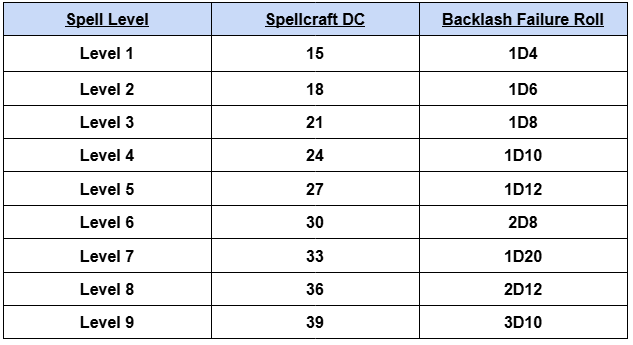
If a Backlash occurs, the players make an immediate Spellcraft check (DCs shown below). Success means they negate the backlash; and failure triggers a random Backlash Effect. Additionally, the caster gains stress equal to the spell level.
Backlash Effects (D30):
Debilitating Weakness: You feel horribly weak and your speed is halved until you gain restful sleep.
Overwhelming Fatigue: Lose one action per turn due to overwhelming fatigue and headache.
Arcane Internalization: Your mind and body strain with arcane energy. Unable to solidify, it disperses within you painfully. Caster takes XD6 - (caster stat) damage (minimum of 1). X is equal to half spell level.
Memory Wipe: Your memory of the last 10 minutes is completely gone; and you have disadvantage on your next 3D6 rolls.
Temporary Blindness: Your vision fades; and you become blinded until you gain restful sleep.
Energy Lacerations: Your skin lacerates as arcane energy crackles throughout you, dealing 2D6 slashing damage.
Violent Retching: You begin to vomit uncontrollably taking 1D4 damage and cannot take actions on your next turn. At the end of your next turn, you must make a DC 11 fortitude saving throw. If you succeed, you regain your composure and may act as normal on your next turn. If you fail, you continue to violently throw up. This continues until you pass the save.
Paralysis: You lose all feeling in your legs and fall prone. Until you gain restful sleep, you are unable to walk or stand and can only use your arms to drag yourself at a speed of 5ft. While in this state, you can only take two actions per turn.
The Ill Flame: You suddenly burst into green flames and take 3D6 fire damage. The fire is otherworldly in nature and cannot be extinguished through conventional means (i.e. water). You continue burning for two turns reducing the damage by 1D6 each time until no dice remain.
Arcane Dissonance - Spell Reversal: Normal spell effect inflicted on caster (or enemy of helpful to caster). Dissonance wracks your body and mind. For the next 2D4 rounds, you can only take one action per turn.
Arcane Dissonance - Partial Reversal (Self): Half spell effect inflicted on caster. Dissonance wracks your body and mind. For the next 2D4 rounds, you can only take one action per turn.
Arcane Dissonance - Partial Reversal (Random): Half spell effect inflicted on a random target. Dissonance wracks your body and mind. For the next 2D4 rounds, you can only take one action per turn.
Arcane Dissonance - Partial Reversal (Target): Half spell effect inflicted on designated target. Dissonance wracks your body and mind. For the next 2D4 rounds, you can only take one action per turn.
Midnight Decay: Midnight colored energy courses through the caster’s veins, rapidly decaying or destroying a part of their body or spirit. Roll a D6 and select the corresponding ability stat, temporarily reduce it by 4.
Life Force Drain: Life energy dissipates out of your body in a bright blue mist, your speed is reduced to 0 and all ability scores drop to 3 until you gain restful sleep. At that time, they increase by 3 per restful sleep until they are back to where they started.
Suppressed Recovery: You are unable to regain Vitality or Fighting Spirit for the next 2D4 days.
Conduit Overload: Arcane power thrums through you, suddenly racing into a random item you are holding. A moment later, it explodes for 1D6 force damage in a 20ft burst.
Total Collapse: Your mind and body give out, instantly dropping your Fighting Spirit to 0 and Vitality to 1, rendering you unconscious but stable.
Lingering Agony: Searing agony courses through you. For the next 2D6 days, you can only take one action per turn.
Spell Block: Your connection to the Arcane is gone. You cannot regain Spell Points during your next 2D6 restful sleeps.
Apocalyptic Vision: A vision of an apocalyptic cataclysm flashes across your mind. The sheer horror of the vision causes you to take 8D8 psychic damage.
Area Spell Drain: You and anyone within a 20ft burst centered around you are stripped of any remaining Spell Points until gaining restful sleep. Additionally, you take 3D8 psychic damage and can only take one action per turn until gaining restful sleep.
Permanent Atrophy: Your mind and body withers and atrophies. All ability scores are permanently reduced by 1.
Eye Rupture: Your eyes burst from your skull, causing 3D6 force damage and permanently blinding you.
Necrosis: One of your limbs turns black, shrivels with decay, and falls off. Strength, con, and dexterity are reduced by 2. The player determines which limb is lost.
Catastrophic Explosion: A fiery explosion erupts from your body, dealing 10D10 fire damage to you and anything within a 30ft burst.
Rapid Aging: You instantly and permanently age (1D4 x Character Level) years.
Supernatural Youth: You instantly and permanently get (1D4 x Character Level) years younger.
Soul Withering: You expend all of your remaining life-force over the course of 1 minute, rapidly aging and decaying before crumbling to ashy dust. Your character dies.
Withering Vacuum: You expend all of your remaining life-force over the course of 1 minute, rapidly aging and decaying before crumbling to ashy dust. Your character dies. At the end of this time, anyone within a 200ft radius suffers the same fate, unless they make a will save DC 26. Upon their death, the vacuum occurs again, slowing shifting across the land until everything is devoured.
Blood Magic:
When necessary, a spellcaster might choose to burn away their own life to empower their spells, using their blood as a conduit to greater power. To do so, the player must declare they are using Blood Magic. Then, they may freely take temporary ability damage on any number of abilities they possess, affecting the result of the spell by the following metrics.
1 point to: Raise the Spell DC by 1
2 points to: Raise the damage by 1 die
3 points to: Apply a metamagic feat (+3 per level increase of metamagic ability)
4 points to: temporarily learn a new spell (+4 per spell level)
Ability damage in this way heals at a rate of 1 point per fully rested week. This is one point total, not per ability, so the player may choose which ability heals after fully resting per week.
New Feats:
The following feats are added to the game:
Learn Spells
Type: General
Prerequisites: Arcane Connection
Benefit: Learn 2 more spells of the highest spell level or below according to your classes spell table. You may take this feat multiple times.
Extra Spell Points
Type: General
Prerequisites: Arcane Connection
Benefit: Gain 2 more Spell Points. You may take this feat multiple times.
Strain Resistant
Type: General
Prerequisites: Arcane Connection
Benefit: Increase your Arcane Strain threshold by 2 to resist Arcane Traumas. You may take this feat multiple times.
Backlash Master
Type: General
Prerequisites: Arcane Connection
Benefit: Reduce Backlash % chance by 5%. You may take this feat multiple times.
Learn Class Ability
Type: General
Prerequisites: Level according to ability and previous abilities for class to a maximum of level 6.
Benefit: Learn a class ability, like sneak attack, wild shape, armor training, etc.
Ascedant
Type: General
Prerequisites: Level 6 or level 6 ability of class you are seeking to ascend in.
Benefit: Learn the 7th level ability of a class. You may take this feat additional times to learn the 8th, 9th, and 10th level ability of the class, respectively. For classes like Cleric, Druid, Sorcerer, and Wizard (with gap levels), you learn the abilities granted from a second domain, bloodline, or school of study.
Ability Training
Type: General
Prerequisites: None
Benefit: You have learned how to push the limits of your body and mind through rigorous training. Choose one ability score. You gain a +2 inherent bonus to that ability the first time you select this feat for that score. Each additional time you select this feat for the same ability score, you instead gain a +1 inherent bonus to that score.
Dauntless Spirit
Type: General
Prerequisites: None
Benefit: Roll an additional HD from your starting class and add it to your Fighting Spirit threshold. You may take this feat multiple times.
Push The Limit
Type: General
Prerequisites: Level 6
Benefit: Nothing is impossible for you. Your brilliance goes beyond what mortals believe is possible, landing amongst legendary heroes and the divine. Whenever you take this feat, choose one of the following:
Athletic: Your BAB is considered two higher when qualifying for feats.
Intellectual: Your Skill Ranks are considered two higher when qualifying for feats.
Magical: Your Caster Level is considered two higher when qualifying for feats.
Once a day, you may reattempt a failed roll, as if rolling with advantage. You may wait to learn the outcome of the roll before declaring but must take the result of the new roll. You may take this feat multiple times.
Hero Points
Hero Points are a term used by many TTRPGs. In my game, they work like this:
Player characters start with 3 Hero Points. Any time they level up, they gain Hero Points equal to their new level. They many also receive Hero Points as rewards for completing quests and story moments.
Using a Hero Point is a free action and can be done anytime before rolling a die. Doing so automatically rolls the dice at its highest number. A player may also use any number of Hero Points they desire in a turn.
Additionally, they may use one Hero Point to heal themselves 1D6 Vitality, or 1D8+1/2 level + con mod Fighting Spirit.
They may also expend five Hero Points to bring someone currently making death saving throws to 1 Vitality. A person who is already dead cannot receive Hero Points.
This creates an environment where players can ensure their character always shines when they really want them to. Often times I’ve seen players stockpile their Hero Points to ensure they can save a dying companion, or burn 3 at once to deal the most damage possible! (1 Hero Point on the attack roll to threaten a crit, one Hero Point to confirm the crit, one Hero Point for max damage.) Now that’s heroic!
Virtues and Vices
Virtues and Vices are roleplaying tools to incentivize players staying true to their characters. At creation, each character must select 3 virtues and 3 vices, ranging in degrees of modest to extreme. When characters perform exceptional roleplay in regards to these moments (usually making a choice that is true to the character but not optimal for the group or players), I will reward them with a Hero Point.
Typically though, it is used to reduce stress (acting in alignment with a virtue or vice) or raise stress (opposing a virtue or vice.) For consistency, I apply 1 stress for modest, 2 for medium and 3 for extreme.
Scale of Influence
Coming from an acting background, the most interesting part of roleplaying games are the relationships. Thus, tracking the players’ Scale of Influence with the NPCS around them creates an environment where relationships matter. If the players know that doing scenes and and engaging will yield mechanical results, it gets even the most battle starved min maxer into the roleplay spirit!
Since implementing this, my playgroup has fallen in love with “soap opera” elements. Often times, it creates the most memorable moments of the campaign.
Not all interactions will change an NPC’s level of influence with a player. While other moments may affect all NPCs. Use your instincts as a DM to determine what moments the scale changes and play the NPC accordingly.
As a rule, I adjust Scale of Influence once at the end of each session. Often times, I only increase or decrease it by one. I find the slow burn creates the best tension for everyone involved and the biggest reward later.
1: Hate: The number that would make the character have a crisis with the player and confront the player. Depending on how they handle the situation, they might abandon the players and leave the party, and possibly become an enemy.
2: Scorn: The number a character will betray you at, i.e. lie, steal, or sell information to enemies.
3: Loathing: The number that they attempt to sway other NPCs to their opinion, such as airing the player’s dirty laundry and past mistakes. NPC rolls appropriate check (such as diplomacy) to lower other NPCs’ scale number.
4: Disgust: The number a character would blindly oppose the player’s thoughts or actions.
5: Hostile: The number a character would challenge you at (fighting or emotionally).
6: Disrespect: The number a character would expose the player’s secret to their team, possibly sabotaging their relationships.
7: Rival: The number a character will do the opposite of what they are instructed to do.
8: Disliked: The number a character goes out of their way to avoid the player.
9: Nuisance: The number a character begins to behave passive aggressively.
10: Neutral: The number a character will harshly give unbiased opinions at.
11: Neutral: The number a character will tenderly give unbiased opinions at.
12: Acquaintance: The number a character will begin to act friendly to the player.
13: Liked: The number a character will share some of their passions or personal information with the player.
14: Ally: The number a character will share their backstory with the player.
15: Respect: The number a character will share their secrets with a player.
16: Loyal: The number a character will ask for help or reveal their personal quest.
17: Affection: The number a character will earn the player’s income during downtime, going above and beyond to help the team.
18: Adoration: The number a character will blindly support you.
19: Reverence: The number that they attempt to sway other NPCs to their opinion, such as sharing their admiration for the player, singing their praises, and telling of their successes. NPC rolls appropriate check (such as diplomacy) to raise other NPCs’ scale number.
20: Love: The number a character would die for you.
When creating an NPC, determine the following:
The number range a character will want to break up.
The number a character will want to court or be courted at.
The number a character will confess their feelings to a PC.
The number range a character will want a committed monogamous romance at.
The number a character will reveal their personal quest.
The number a character will give a meaningful gift.
To really maximize this system, implement a “Downtime” session between each adventure. During the session, let the players select any NPC to do a scene with. This scene always affects Scale of Influence with the NPC of their choice. Then, select another NPC at random for them in this same fashion. Watch as the glorious soap opera unfolds! Another trick is to ensure your game is filled with moments and decisions that raise the Scale of Influence, or NPCs lowering it with others. Choices. Consequences! Drama!!!
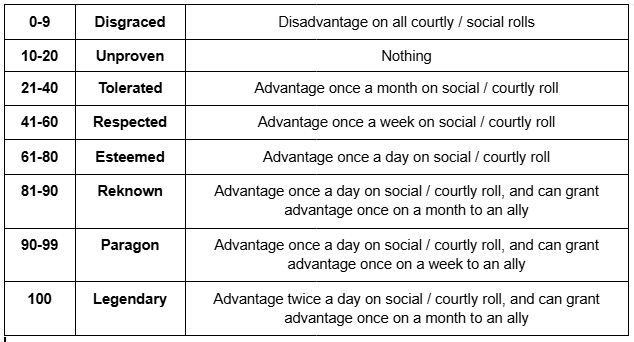
Honor and Reknown
Honor represents how other people along the Coast view your character, separate from their personal feelings for you. Those who lack honor are seen as untrustworthy, faithless, and disloyal. Those with Honor are considered the best of the realm.
Your base honor begins at 5 times your level, plus your charisma modifier.
Honor shifts at the end every session, when players recount their deeds. If their behavior was subtle and not likely to reach beyond the area they were in, they roll a D6, raising or lowering their Honor accordingly. If word of their deeds was great enough to spread beyond the area they were in, then roll a D10 instead.
Additionally, each time a player moves into a new category for the first time, they gain a Hero Point.