
The Earth Brother
The Earth Brother
Quote: “Wickedness grows in fields good folk avoid.”
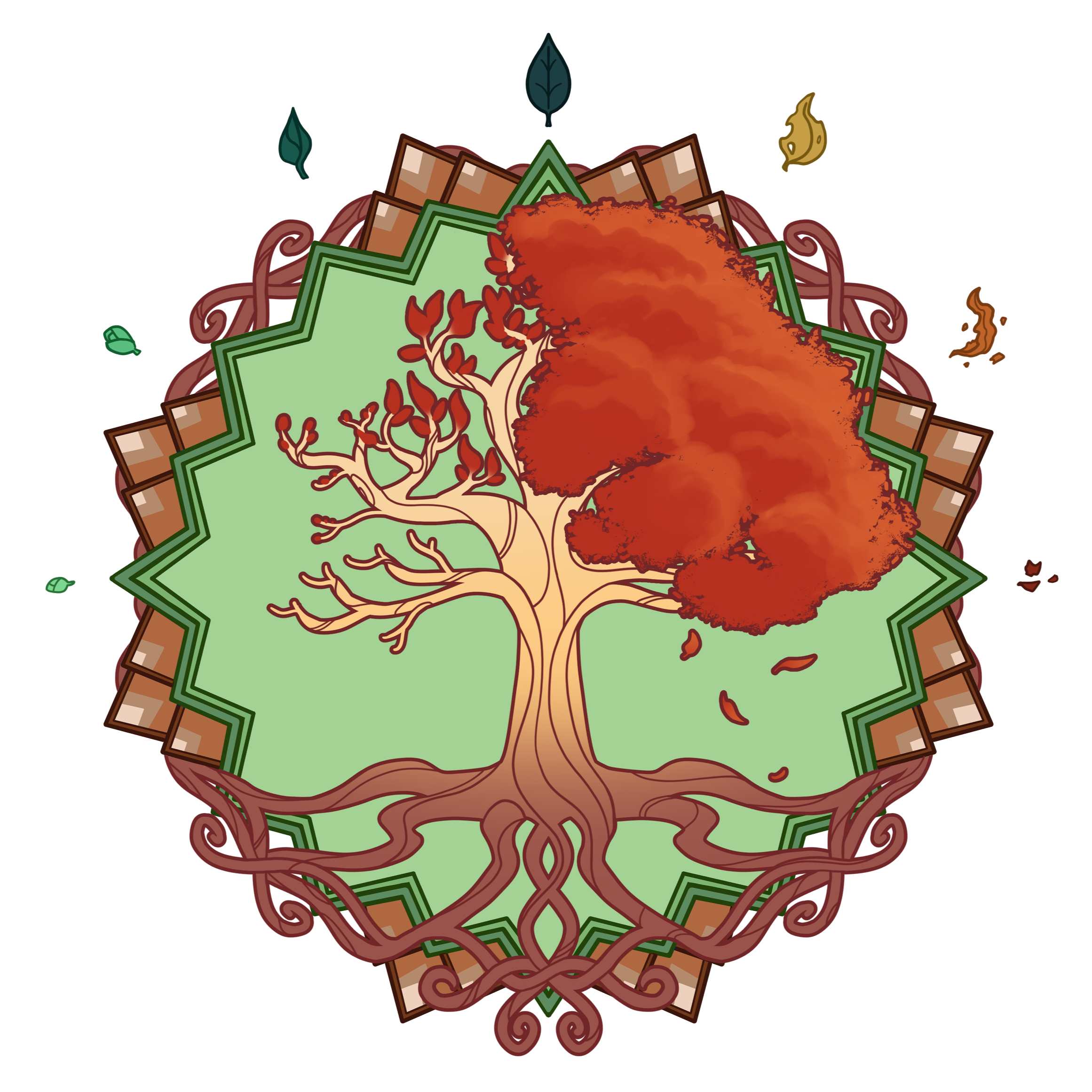
Holy Symbol: A tree split in season, surrounded by a ring of hills and mountains.
God Nickname: The Monument, Old Joyful, Sir Steadfast
Favored Weapon: A two headed axe, and tower shield.
Honored Blood: Middengaerd Zemlji, the Massive and Ever Laughing
Paladin Alpha: Gwyndairis Diatorna, Nature’s Favored
~ Bio ~
The Earth Brother stands for all that is enduring, joyful, and breathtaking. They sought to find merriment in the world his parents battled for, often shirking their duties and avoiding hard truths. The Sacred Texts define his journey as such:
While the Sun Mother and Moon Father fought the Terror in shifts, the Earth Brother walked the bleeding ground, refusing to take a weapon in hand. “Let they who seek it wage war! I shall draw no blood in my time.” He set his back against a rise, opened a skin of wine, and let the hours pass. Where he lounged, the dead world turned anew, grass thickened beneath him and trees rose to brace his shoulders offering shade. He was beloved, and all in his vicinity wished to laugh and drink beside him.
In time Sister Sea scolded him for his lazing, insisting her take up arms and join the fight. “That is your way, dearest sister. Mine is to idle and feed. Someone ought to enjoy the fruits of your labor, since you all insist on eternal toil.” His sister was furious, but even her wrath would not inspire him to act. “If it sours you so, then let me toil another way. Allow me to make you shelter from this spoiled land, then you can rest well, and fight all the harder.” She relented, and Brother Earth set to work.
The land eagerly shifted to his needs, and soon his family had temples a plenty, fortresses to hide in, and glades for recovering. Satisfied, he built himself a staggering castle and retired. On the slopes around it a vinyard blossomed, and he drank deep from dawn to dusk. But word of his inebriation reached the festering agents of the Terror, and under the cover of darkness sprung upon the Earth Brother.
He fought them best he could, but he was unskilled and lacked the strength. Their teeth dug into his neck, and tore it to ribbons. “Woe is me!” He cried, “Mother! Father! To me! To me!” His voice was thin and dying. But moments before his last breath, Sister Sea appeared on lightning’s lance and eviscerated the monsters hounding him. She treated her brother's wounds, and left him on few words.
“This is what denial wroughts little brother. Laugh if you can, but it will not save you from the depraved and wretched.” She stepped out into his courtyard and brought with it her rain and storms. She called another bolt from the clouds and struck a wing of the castle and the largest tree in the yard. The storm blew the wreckage back to the brother, a perfect haft and massive axe head formed of crumbled castle stone.
“Build on if you must. Your way is yours alone. But we will stand beside your traitoring no longer.”
The storm swelled, moving through the valley, and the sister went with it. Brother Earth recovered slow, but forged the axe pieces into something new and whole and deadly. For centuries he sought only to build, denying her words. Running at the first sign of trouble. Time and time again his heart proved himself a coward.
In time, the Sun Mother came to rest in his castle. He eagerly welcomed her, offering her feasting and his finest wine to heal her. But each day when he took the fields, his crop and vine withered, pooling into ichor black. From the edges he could see the Terror’s agents waiting, hungry and violent. For a week he could not face them, and his Mother starved. Not once did she ask of him, or scold his ways. Seeing her deplete, his loathing for his weakness grew and in a rage shouted, “I am no killer! My hands build, not destroy! Yet you twist the knife in my belly, and rust what I cherish! For her. For them, I shall spill blood at last.”
The massive god strode into the fields, and swung his axe with the power of his father. The wretches died fast, and their blood became flowers on his hillside. With their deaths he made good on his promise to his mother, and relented. “A laugh is a hollow and empty thing, when there is no one to join you in it.”
-A Reason For War, The Sacred Texts, As Written by the Prophet Landar
Those who worship the Earth Brother strive to learn from his mistakes, indulging in play only after their work has finished. They are often pillars of their community, quick to be generous, and stalwart defenders of justice. Just as the Earth Brother traveled the land, fighting the rot and sewing seeds, so to do the faithful. They are explorers at heart, with a farmers touch, and always prefer mediation over violence.
~ The Church ~
Devoted of the Earth Brother live in a pastoral communal village, believing that many hands make for light work, that joy and toil should be shared in equal measure, and no man is meant to be alone. Their gates are always open, and welcome anyone to their fold without question, so long as they’ll join in the day’s tasks. Life in the church of the Earth Brother is not all that different than life as a farming peasant, save for the exceptional community around them, and access to all manner of remedies, foodstores, and craftable goods.
~ The Temple ~
Set atop a rolling pastoral hills, this verdant countryside is a collection of farms, homesteads and communal structures. Long stone walls enclose the massive acrage. Inside them the land is worked in broad bands: rows of crops, kitchen and herbal gardens, spawling vinyards, lanes of orchards, and grazing ground for the herds. Homesteads and communal halls sit on juctions along the paths, welcoming the clergy and pilgims alike.
A river stream meanders through the yards and passes a line of barns built on its banks. The current turns grind wheels that channel water into troughs that nurse the fields, and mill the grain for the storerooms. Smoke rises slowly from these mighty estates, bringing with it the pleasant smell of woodfire.
Cobblestone roads form the main roads, while dirt paths branch off it into the crop and under the trees. Small woodlands breaks the open ground in stands of oak, while the tallest of them hold small look-outs and private homes in their upper limbs. From them, one can see a jagger tor rising on the far side of the estate. A stone door thrumes with power carved into its side, and leads underground to the temple proper.
~ Interior Locations~
The Descent
Beyond the thrumming door, a set of steep stone stairs drop into the hillside. Roots and soil cling to the edges and scale the walls, and have been worked to hold small candles, offering a pittance of light.
The Threshold
The stairs spill out into a wide chamber, its ceiling low enough that the taller stalactites nearly meet the rising knobs of stone on the floor. Still moving through the space does not require crouching. Fungus mats make lines of carpet across the space, and ocasionaly puff up with dim light. A root as thick as a trunk comes down through the ceiling near the center and disappears into a crack in the floor, while smaller roots web the walls. Niches cut along both sides hold clay lamps, providing lanes of light. The smell of wet soil pervades the place.
The Nave
Passing through the threshold’s final arch and the ceiling lifts, welcoming you to a high cavern with stalactites overhead and stalagmites rising to form lanes. Dark green rugs lie between the stone pillars, flanked by candelabra that burn along the aisles and shine ample light. Stone benches face down the length of the cavern toward a rise at the far end, set in two blocks with the rug running between them.
The Altar
At the far end of the nave a rise in the cave floor holds an altar made of fused stone. Its rough, porous sides catch the shadowed light while its polished top shines and reflects. A great axe leans against its face, far too large for a man to weild. The steel head is broad and pale, its edge jagged and chipped. Two shallow bowls sit on the altar, one filled with wine the other with sap. Root columns frame the rise on either side, and stalactites hang low over the stone. The fungus light is thicker here, illuminating the alcove in phosphorescent light.
The Gem Garden
A side passage off the nave opens into a long gallery that runs deeper into the hill. Worked stones and cut crystals cover low stands and the ledges along both walls in every possible shade, each piece shaped by hand and set out as an offering. Above the offerings, niches are cut one above another into the same walls, and a name is set in the stone over each resting place. Here the dead of the faith are inturned, and honored in all memoriam. Water seeps along one wall and feeds a narrow trough that crosses the gallery. Light from the candelabra catches the crystals and casts prismatic refractions across the niches in a dizzying display.
The Holy Forge
A long hall leads of the naive toward warming air, before opening into a round chamber. A vent in the floor breathes heat, and a bed of coals sits banked in a stone hearth. Over it rises a ring of blackened stone, its inner lip glowing red hot where the coals touch the rock. The ring is cut from the same stone as the tor, and a slab of castle rock is set into its face, pale against the soot. The sacred texts claim it was taken from the wreckage the Sea Sister’s bolt struck loose. An iron hood hangs above the ring on four heavy chains, funneling the smoke up and out the tor above. Half-finished blades lie on benches and all manner of tools fill racks on the walls.
The Choir
A smaller, rounded cavern rest near the altar. Stalactites hang overhead, blocking off stone seats that curve along the wall. When service is held the choir sits here, and fills the cavern with echoed song.
The Seed Crypt
A short stair drops from the nave into a cool room. Shelves are carved into every wall, and clay jars and sealed gourds fill them. Here all manner of seeds and alchemy are stored, ensuring the grounds are never barren.
~ Exterior Locations~
The Stone Walls
Long walls of mishapen and rough stone enclose the full acreage of the Earth Brother’s domain, running across the ridges and trenches alike. At most places they stand ten feet tall, but in some places time has worn them low. Gates break the wall at a northern, eastern and western point, making for ease of travel across the coast.
The Main Gate
The northern gate faces the coast road, and is made of two massive timber planks hung on stone posts that bare the Earth Brother’s crest. Barred from the inside inside with a beam that requires a team to life, very few are welcomed inside after dark. A hearth warden remains stationed here welcoming pilgrims and merchants, and a tower outpost looks down on the land outside the temple.
The Cobblestone Road
A cobblestone road runs from the main gate straight to the foot of the tor. It is wide enough for two carts to pass, trenched so rain spills to the fields, and flanked by dirt paths that branch out across the grounds.
Crop Fields
Dozens of thriving crop fields wave in the breeze, set in long parallel rows. The faithful tend to them daily, ensuring what is ready is brought to the Harvest House.
Orchards
The orchards stand in loose grids along the eastern hills, where all manner of fruit are cultivated by the season. Ladders and picking baskets live in a shed at the orchard’s entrance, alongside a rest house for those in need of breaks.
Vineyard and Bistro
The vineyard covers the western slope in terraced rows of vine, while the mess hall overlooks it. Made from dark wood and bright stone, this building wraps around a square courtyard filled with trees and bright gardens. Arching terraces covered in vine form the entries, and a fountain bubbles at the center. No mater where one sits, a breathtaking view of the estate greets them, looking down on nearly the entire plot. Bards from all across the coast travel to perform here, declaring it one of the most picturesque locales in all of Avalayle.
Apiary
The apiary sits across the orchard groves, a row of hives on low stands. The bees work the vineyard, many gardens, and wild flowers throughout the estate. The honey they produce is stored in a shed near by, and later moved to the Harvest House or Bistro.
Brewery
The brewery sits on the bank of the stream where it bends below the vineyard, a broad timber building raised on stone piers so the water runs under the floor. The lower room holds the vats and the stacked casks, and the grind of the nearby barn wheel carries through the boards. A wide stair climbs from that room into the tavern above, where long tables fill the center and a bar of worn plank runs the length of the stream-side wall. Large open windows give a promiant view of the stream on one side, and the climbing vinyard hills on the other. Barrels and chairs serve as seating, around the tables which are pressed toward the walls. The center space is reserved for dancing, where smooth boards and a low stage await musicans and merry makers.
Grazing Fields
The grazing fields lie scattered throughout the ground, inbetween the numerous plots and along the edges. All manner of farm animals roam about, and are put to work when called upon.
The Stream
A stream rolls through the estate from the mountains beyond, passing first the tor before winding through the hill beyond. Barns stand along its banks and make use of the current. Waterwheels drive millstones and raise water into troughs that nourish the plots. Small stone bridges allow for crossing, just wide enough to fit carts.
Harvest House
The Harvest House stands along the cobblestone road, as a midpoint between all of the fields. This massive barn serves as silo and cellar, storing all manner of grain, fruit and meat. Beside it, the Entrenched Barracks keep a close watch for thieves. Once a month, the temple welcomes all manner of pilgrims with empty baskets, letting them leave with their fill.
The Entrenched Barracks
The barracks of the Entrenched stand opposite the Harvest House, a long block of fieldstone with a dirt yard. The walls are thick, the windows narrow, and a pair of heavy timber doors face the cobblestone. Inside, the main hall runs the length of the building, where weapon racks line both walls, holding great axes and masterwork farm tools. The rooms within are simple, but contain all the needs required of someone getting through the night.
The Hilltop
Rising a ways beyond the barracks, this hilltop is lined with a small fence. Inside it, the ground has burned and been made into a pit of fine soil. Here, the Hearth Wardens train in their uniqure brand of fighting. Throughout the day, warriors can be seen thrown up and over the fence, rolling down the hill in brutal tumbles.
The Mud Pit
Beneath the hilltop, in a shade alove, a mud pit fills a rocky basin. Fed by a warm spring that keeps the clay soft, the mud here is dark, and used for healing. All members of the faith and pilgrims alike wade waist deep into the pit, and soak in the warmth. Linen and a rinse trough sit on a deck beside the rim, maintained by Younglings.
Old Joyful’s Rest
A single massive tree with dark red leaves towers over a lonely hill on the southern rise. Two circles of dotted stone surround the tree, lined with prayer tags form a singular pathway to its trunk. The bark weeps a thick sap, amber-red and honey sweet. Elderlings collect it in cups at each new moon. The space is considered one of the msot holy within the temple.
The Standing Stones
A circle of cracked monoliths rises on an eastern ridge, and is believed to have been placed there by the Earth Brother himself. Each monolith is made of different stone, and none from the surrounding region. Runes glisten to life under the light of the full moon, and welcome those seeking prayer, guidance, and or empowerment.
Tree Houses
Private homes and small look-outs occupy the upper limbs of the tallest oaks scattered through the sparse woodlands. Ladders or nailed in stairs climb the trunks, leading to a modest platform containing a bed, wardrobe, and a clear view of the paths below. These homes are often kept by the youngling, who practice connecting to the natural world around them before graduating to the cloister villa.
The Cloister Villa
The cloister villa rest off the cobblestone road a short stretch before the tor. This homestead wraps around an open green courtyard, where a covered walk runs along the inner sides. Posts along the walk hold the second story, and doors run the length beneath it, leading to private rooms. Each room holds a bed, a wardrobe, a desk beside a window, and a chest at the foot of the bed. The windows face either the court or the fields beyond, and welcome the days light. A shared washing room sits at one corner, with a stone basin fed from the stream and linen hung on pegs along the wall. Herbs and small gardens grow in the courtyard.
The Giant Boar
A giant boar keeps mostly to the grazing fields and the woodland edge beyond them. Taller than most men, the powerful creature keeps to itself. The temple treats him as a proper resident and regualrly leave offerings for him at his season dens.
The Tor
At the far end of the cobblestone the ground rises into a jagged tor. A stone door cut into its side leads deep into the hill, where the temple itself awaits.
The Ruined Castle
The ruined castle stands on a rise on the south-easten ridge. The walls are still high in places, but most have crumbled, sheared down to a tumbled foundation. A broken stair climbs to an empty arch, and toppled second story. The largest tree in the yard is a stump, blackened, with a new growth pushing out around it. The faithful believe this is the tree the Sea Sister struck, forming the Earth Brother’s mighty axe. Two benches face each other across a low block in the center, and a third seat sits at the head.
~ The Entrenched~
The Entreched serve as the Church of the Earth Brother’s Hearth Wardens. Sworn to the Temple and Honored blood, these diligent folk defend the temple grounds, toil the fields, and seek to travel the coast to witness the God’s splendor.
The Entrenched are by far the most armored of any paladin order. Heavy plates of bronze and copper layer over each other ensuring they have no weakpoints. Dark green capes hang from their shoulders and double as cloaks, while amber pendants shine in the light.
They fight with the double-sided axe in one hand, and a tower shield in the other. In most instances, only the shield is drawn, as members of the order seek to negotaite for peace before ever entering into conflict. Often times, even as battle errupts, they will surround their foes with only shields drawn, and batter them into a cowering state. Only when an enemy can not be quelled will they look to kill it.
Unlike some of the other faiths, the Entrenched live the every day lives of Younglings and Elderlings, working the land and altar with reverance. Once a season they are excused from these duties and enter three day long trial. Throughout it, they are made to fast, and march the perimeter in full plate. At the end of the ordeal, they form a meditation circle in the ruined castle, and break the fast the following sunrise drinking the holy sap collected from Old Joyful’s Rest.
Any who wish to join the Entrenched must complete this ordeal first, then recieve further training. While most of their ranks remain on the temple grounds and protect the clergy, any are welcome to roam the land, spread the Earth Brother’s message, and witness first hand the joys the Kindred Gods have bestowed on man kind.
~ Extra~
Acts of Service:
Maintain a small garden or farmplot, and come harvest time, set aside the best crop for the Earth Brother.
Stack stones throughout the month, each day adding one more to the pile.
Fasting
Carve protective runes into stones and wood, and leave in areas that need the Earth Brother
Pour a splash of wine into an offering bowl and leave outside over night
Holidays:
The Autumn Equinox
The Spring Equinox
The Revelry- Often celebrated after harvests, long nights of dancing, drinking, and merriment, rewarding oneself after a season of hard work.
The Great Blooming- Test of courage presented to youths, considered a rite of passage and way into adulthood.
The Long Sit- Folk gather in a communal circle and share old tales, while working collectively on stone carving, wood whittling, and other crafts. Each hour a bell rings out and the objects are passed throughout the circle, leading to a collection of unique goods and trinkets to be used in the season ahead.
The Rising- A contest of strength, held for fun and competition. Competitors throw logs, carry boulders and wrestle, leading to a single champion dubbed, The Mighty Mountain at it’s finish. For the remainder of the week, the Mighty Mountain is treated as a celebrity and gorges themself on fine food and drink.
Aphorisms:
“Smile on.”
“Unmovable as the Monument”
“Play is only as joyful as the work was tiring.”
“Sow the seeds of a better tomorrow.”
“May the Brother watch your crop.”
Attire:
Dark brown linens with green acents. Leather and fur armors, and simple garb that allows for work in the fields.
Coastal Heralds:
Bison, boars, and insects